SQAAF Workshop: The Architecture of Excellence for School Quality Improvement
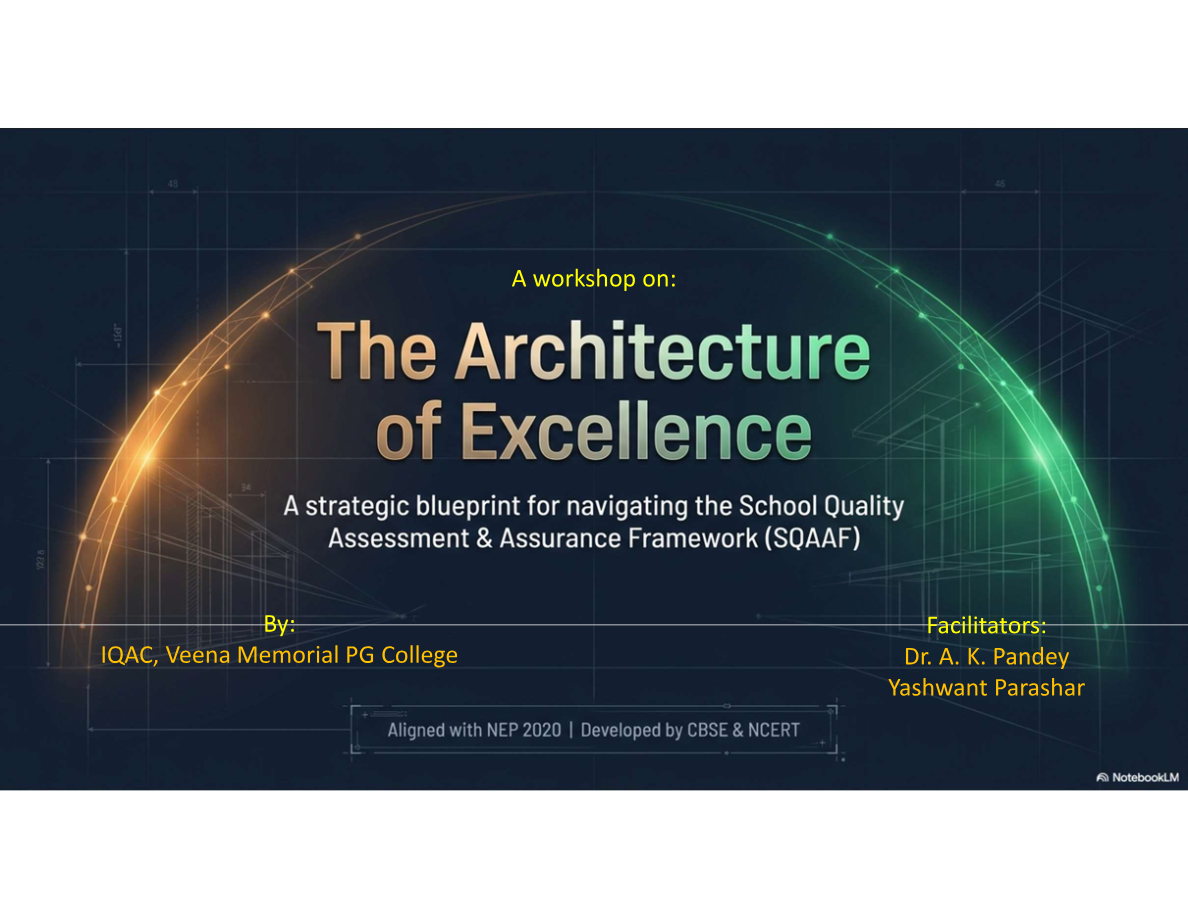
The SQAAF workshop titled The Architecture of Excellence positioned school quality as a deliberate, evidence-driven system. Conducted by IQAC, Veena Memorial PG College, and facilitated by Dr. A. K. Pandey and Yashwant Parashar, the session translated the School Quality Assessment and Assurance Framework into a practical blueprint for institutional improvement.
The central message was clear: SQAAF is not a one-time inspection. It is a continuous improvement engine that helps schools define quality, assess present practices honestly, create targeted improvement plans, and measure better outcomes for students, teachers, and the school culture.
Workshop Source
This article is based on the SQAAF workshop slide deck, The Architecture of Excellence: A Strategic Blueprint for Navigating the School Quality Assessment and Assurance Framework.
View Workshop PDFFrom Inspection to Improvement
The workshop contrasted the old compliance model with the SQAAF model. In the old model, quality often meant fault-finding, bureaucratic inspection, and meeting minimum standards during a stressful external event. SQAAF changes that culture by shifting the focus toward evidence-based capacity building, continuous internal assessment, student-centric development, transparency, collaboration, and empowerment.
This shift matters because schools do not improve through isolated events. They improve when teams repeatedly ask what is working, what evidence proves it, what needs to change, and how progress will be measured.
The 4R Quality Cycle
The engine of SQAAF is the 4R quality cycle. It gives school teams a disciplined process for converting reflection into measurable action.
- Review: Where are we now? What are we doing? Why are we doing it?
- Reflect: Where do we want to go? What is working or not working? How did we get here?
- Respond: How will we bridge the gap between the present reality and the desired standard?
- Rate: How do we evaluate our efforts, and is the work making a real difference?
Understanding the SQAAF Measurement Chain
One of the workshop's most useful explanations was how qualitative school practices become measurable maturity. The framework begins with broad domains, moves into focused sub-domains, defines expected standards, checks observable indicators, applies rubrics, verifies evidence, assigns a score, and finally maps the school's maturity.
This chain prevents SQAAF from becoming opinion-based. A school does not claim quality merely because a practice exists; it proves quality through documents, data, records, feedback, and implementation evidence.
Curriculum and Pedagogy at the Core
The framework gives the highest weightage to Domain 1: Curriculum, Pedagogy and Assessment. This domain carries 40% weightage and includes 7 sub-domains and 26 standards. Its emphasis is alignment with NEP 2020, competency-based learning, and evidence-driven assessment.
The remaining six domains carry 10% weightage each and support the learning ecosystem:
Infrastructure
Physical and digital resources, safety, and optimization across 12 sub-domains and 20 standards.
Human Resources
Teacher recruitment, deployment, CPD, and welfare across 5 sub-domains and 10 standards.
Inclusive Practices
Equity, gender sensitivity, and special needs support across 5 sub-domains and 7 standards.
Management and Governance
Statutory compliance, financial management, and transparency across 10 sub-domains and 10 standards.
Leadership
Vision, accountability, and strategic development across 3 sub-domains and 5 standards.
Beneficiary Satisfaction
Health, safety, life skills, and co-scholastic development across 6 sub-domains and 6 standards.
Maturity Is Incremental
The workshop described progression as an incremental and cumulative journey. A Level I or Level II position is not a failure; it is the starting coordinate for improvement. Schools can self-assess their baseline maturity, define an aspirational target level, and create a custom action plan for each domain.
Level I: Inceptive or Emerging
Systems are in the initial stage, practices are individual-based, and formal documentation may be limited.
Level II: Transient or Developing
Processes are documented but inconsistently applied, and practices are generally corrective.
Level III: Stable or Proficient
Systems are defined, documented, consistently implemented, and monitored with reliable evidence.
Level IV: Dynamic-Evolving or Innovative
The school demonstrates benchmarked processes, self-evaluative planning, proactive improvement, and practices that can guide other schools.
The Evidence Bank
SQAAF is not about creating extra paperwork for its own sake. The workshop emphasized that evidence already exists in daily school life. The task is to capture it systematically.
- Pedagogical evidence: Lesson plans, student portfolios, and assessment records.
- Administrative evidence: Circulars, attendance registers, and meeting minutes.
- Digital evidence: ERP reports, website updates, digital records, and videos.
- Feedback evidence: Online surveys, training reports, and certificates.
Self-Assessment Roadmap
The workshop converted SQAAF implementation into an eight-step roadmap that school teams can manage like a project.
- School team: Form diverse evaluation committees.
- Evidence collection: Gather policies, registers, and digital proofs.
- Assessment: Rate the school against the 4-level rubrics.
- Gap analysis: Identify the distance between current reality and the ideal state.
- Action plan: Formulate the School Improvement Plan.
- Implementation: Execute targeted improvements.
- Review: Monitor progress through data and feedback.
- Continuous improvement: Lock in gains and restart the cycle.
Shared Responsibility and the Role of IQAC
SQAAF cannot be outsourced to one department. School leaders provide strategic vision, resource allocation, statutory compliance, and culture building. Teachers contribute through lesson planning, competency-based instruction, portfolios, and parent communication. The Internal Quality Assurance Cell coordinates internal audits, data collection, monitoring, and the School Improvement Plan.
The workshop described IQAC as the system navigator, not internal police. Its role is to centralize evidence repositories, maintain the quality calendar, support teacher development, facilitate professional learning communities, conduct internal reviews, track academic progress, manage feedback loops, and maintain the innovation register.
Turning Gaps into a SIP Matrix
The School Improvement Plan must be specific. A useful SIP matrix identifies the gap, the action required, the person or team responsible, the timeline, and the expected measurable outcome.
Example from the workshop
If ICT integration in primary classrooms is inconsistent, the SIP should not simply say "improve ICT." It should specify actions such as procuring smartboards, training teachers in digital pedagogy, assigning procurement and training responsibilities, setting a Q2 academic-year timeline, and defining an outcome such as 100% of primary lesson plans including digital experiential learning.
Common Roadblocks and Practical Responses
- Overwhelming documentation: Digitize and decentralize evidence collection through shared drives.
- Resistance to change: Frame SQAAF as professional empowerment, not compliance.
- Lack of time: Integrate evidence gathering into existing daily routines, including photo uploads and regular records.
- Infrastructure limitations: Start with pedagogical improvements that require no budget and create early wins.
A 12-Month Implementation Roadmap
Months 1-3: Preparation
Conduct orientation, form IQAC, and complete baseline planning.
Months 4-6: Assessment
Collect evidence actively and complete internal evaluation against rubrics.
Months 7-9: Action
Draft the SIP and begin targeted improvements.
Months 10-12: Review
Monitor outcomes, audit data, and lock in best practices for the next year.
10-Point Readiness Checklist
- Accept quality as a continuous journey, not an inspection.
- Align all goals with NEP 2020 principles.
- Form an empowered and collaborative IQAC.
- Transition from fault-finding to evidence-finding.
- Use the 7 domains as a holistic ecosystem model.
- Honestly map the current reality on the 4-level rubric.
- Build a highly specific School Improvement Plan.
- Distribute leadership so every teacher becomes a quality manager.
- Digitize the evidence repository to save time.
- Remember that every child matters, every teacher matters, and every school can excel.
Conclusion
The SQAAF workshop makes one principle unavoidable: excellence is built through systems. When schools define quality clearly, collect credible evidence, distribute responsibility, and treat improvement as a recurring cycle, SQAAF becomes more than a framework. It becomes a working culture.
Schools should initiate their self-assessment roadmap early, use the SQAAF portal collaboratively, and pace the workload across the academic year. Sustainable improvement is not achieved by rushing the assessment stage; it is achieved by patiently building the evidence, habits, and ownership that make quality visible.
Dr. A. K. Pandey and Yashwant Parashar
Facilitators, SQAAF Workshop